In-House Designer vs. Design Agency for Startups
Most founders frame this as a budget decision. In reality, it is about what your startup actually needs from design right now and which model can deliver it.

7 min read
Copy URL
Copied!
At some point, every startup founder faces the same question: should we hire an in-house designer or work with an agency?
The standard advice frames this as a budget problem. Agencies cost more upfront, in-house is cheaper long-term, pick based on what you can afford.
That framing is wrong. The real question is not about cost but about what your company actually needs from design at this stage and which model is structurally capable of delivering it.
Both options have real strengths and both have failure modes that founders rarely see until they are already committed. This is an honest breakdown of how each one works.
The in-house advantage
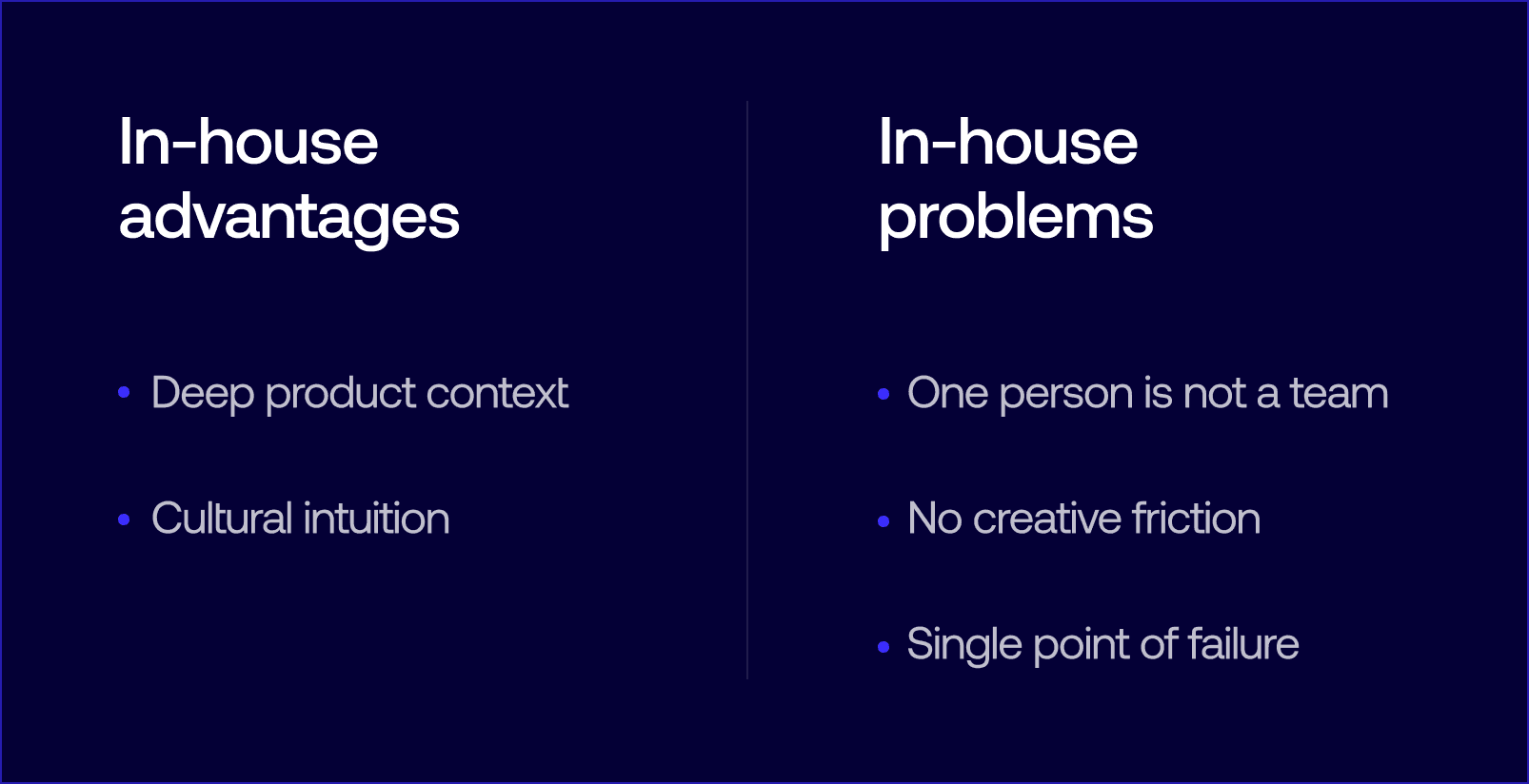
Deep product context
The obvious advantage is proximity. An in-house designer lives inside your product, your roadmap, and your team's daily rhythm. Over time, they build deep context that no outside partner can replicate.
They understand the product's edge cases, the internal shorthand, the unwritten priorities. That context compounds.
For startups with a clear product and a steady pace of iteration, this is genuinely valuable. A designer who is embedded in the team can move faster on day-to-day decisions because they don't need to be briefed, they already know.
Cultural intuition
The less obvious advantage is cultural. A designer who sits in standups, hears customer calls, and watches the product evolve in real time develops a kind of intuition about the company that is hard to transfer.
This is the real argument for hiring in-house, not the cost savings.
The in-house problem
One person is not a team
The problem is that some startups hire a designer before they know what they need one for.
A single designer is not a design team. They are one person with one set of skills, one aesthetic perspective, and one level of experience.
If your startup needs brand work, a marketing website, product UX, pitch deck design, and a set of investor-facing materials, you are asking one person to operate across five different disciplines. Most designers are strong in one or two, and the rest will be competent at best.
No creative friction
A designer working alone inside a startup has no creative friction. No one to push back on their ideas, no art direction, no peer review.
They are often the only person in the room who thinks visually, and the quality ceiling is whatever that one person can produce on their own.
Single point of failure
If that designer leaves, you lose all the accumulated context overnight. If there is no documentation and no second person who understands why things were built the way they were, you have to start over.
The agency advantage
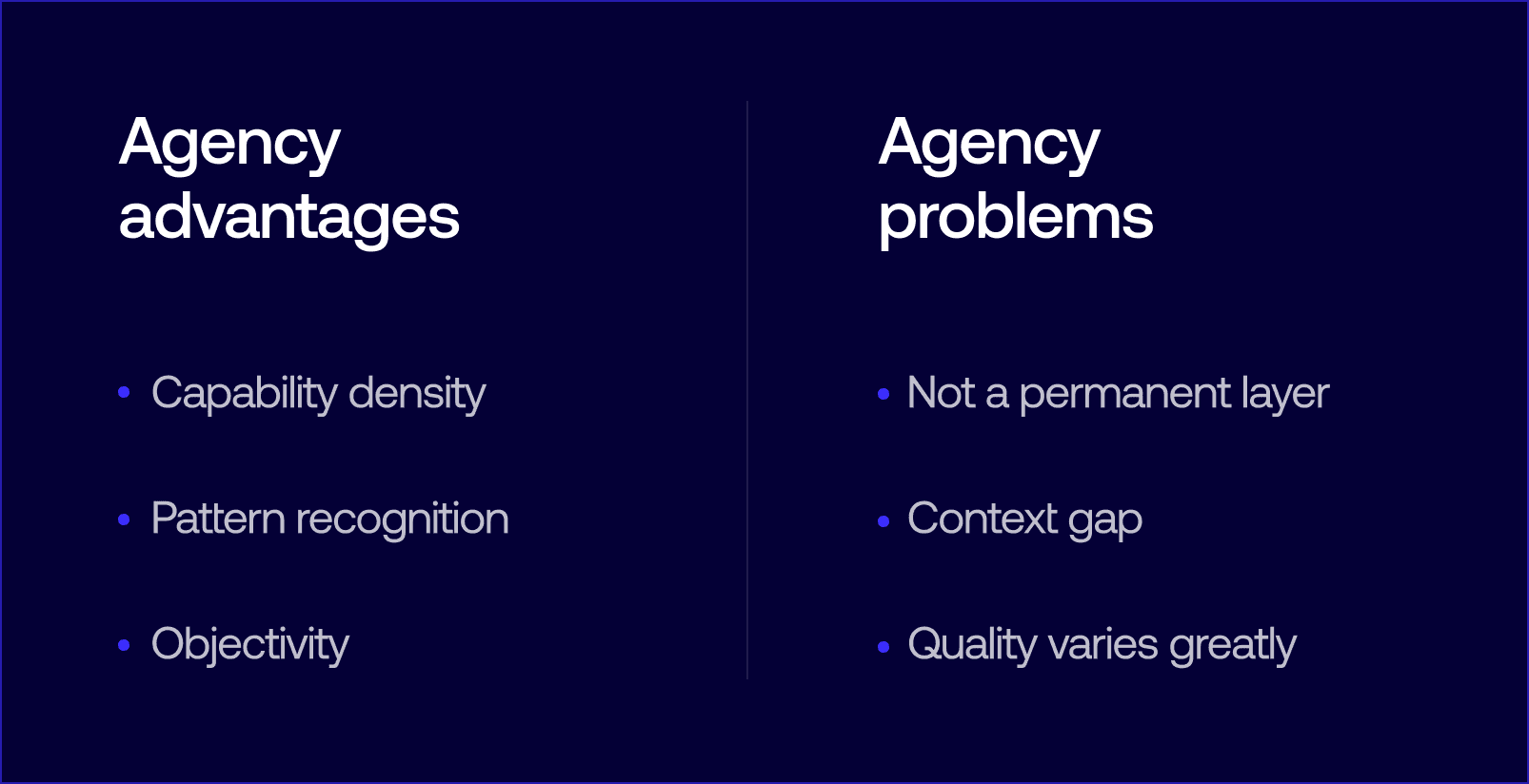
Capability density
A good agency gives you access to a team of specialists, not just one generalist. Strategy, art direction, UI/UX, motion, development, all coordinated under a single engagement.
For a specific project with a defined scope, this concentration of skill is almost impossible to replicate in-house without significant headcount.
Pattern recognition
Agencies that work with startups repeatedly have seen the same problems across dozens of companies. They know which homepage structures convert, which messaging frameworks work for investor-facing sites, and where most founders make positioning mistakes.
Objectivity
An agency has no internal politics, no attachment to previous decisions, no reason to protect what already exists. They can tell you that your current website is not working and explain exactly why.
An in-house designer who built that website or inherited it from a previous employee, has a much harder time making that call.
The agency problem
Not a permanent design layer
Agencies are a concentrated engagement with a beginning and an end. If your company needs continuous, daily design output, an agency relationship will either become unsustainably expensive or structurally awkward.
The context gap
No matter how thorough the onboarding, an agency will never know your product the way someone who uses it every day does.
For deep product UX work that requires understanding complex user flows and edge cases, this gap matters. Agencies can close it with strong research and collaboration, but it takes time and effort on both sides.
Quality varies enormously
Not all agencies are built the same, and the difference is not always obvious at first glance.
A good agency will challenge your assumptions and produce work that elevates the company. A mediocre one will produce deliverables that may look good but do not actually solve the underlying problem.
The decision framework most founders get wrong
The mistake is treating this as an either/or decision based on budget. The better framework is based on two questions:
What kind of design problem are you solving?
If it is a defined, high-stakes project, like a website redesign, a rebrand, or a product launch, an agency is almost always the better choice. You need concentrated expertise for a finite period.
If it is ongoing, incremental product work, like daily UI iteration and feature design, an in-house designer makes more sense.
What stage is your company in?
Early-stage startups change direction constantly. This is where agencies and senior freelancers tend to deliver more value because they can work within ambiguity and still produce strong, strategic output.
Post-Series A, when the product and roadmap are more stable, in-house hiring becomes a much stronger investment. But the highest-stakes design moments actually get bigger at this stage: a full rebrand, a website that needs to match a new market position, a new product launch. One designer usually cannot carry those alone.
The founders who get the best results use both, but at different times: an agency for the moments that shape how the company is perceived, and an in-house designer to own the product experience and build on that foundation every day.
Ongoing work | Project-based | |
|---|---|---|
Early stage | Freelancer / Agency | Agency |
Later stage | In-house | Agency |
What this looks like in practice
Agency first, in-house second
A common pattern among well-run startups: they work with an agency to establish their visual identity, website, and core marketing materials before or shortly after a funding round.
That engagement produces a design system and a set of assets that an in-house hire can then maintain and extend.
The reverse is more expensive
Hiring a junior or mid-level designer first and then bringing in an agency later to fix what was built means paying twice. The agency has to undo decisions before they can build forward.
The sequence matters: get the foundation right with people who have done it before, then bring someone in-house to build on top of it.
The honest summary
There is no universally correct answer. But there are patterns that consistently lead to wasted money, inconsistent output, and lost time.
Hiring in-house too early, before you have the clarity and volume to keep a designer productive, can become a costly misstep for some startups. It feels like the responsible, cost-effective choice. In practice, it often produces mediocre work across too many surfaces with no system holding it together.
Working with the right agency at the right moment, especially for high-stakes, outward-facing work like your website and brand, gives you access to a level of craft and strategic thinking that a single hire cannot match. The investment is higher upfront, but the output sets the trajectory for everything that comes after.
The best decision is the one that matches your actual situation, not the one that feels safest.
Frequently asked questions
Is it cheaper to hire an in-house designer or work with a design agency?
In-house appears cheaper on paper, but the total cost includes salary, benefits, tools, management time, and the opportunity cost of limited skill range. For defined projects, an agency often delivers more value per dollar because you are paying for a team, not a single contributor. For ongoing daily work, in-house becomes more cost-effective over time.
When should a startup hire its first in-house designer?
Typically after the company has enough product stability and design volume to keep a full-time designer consistently engaged. For most startups, this is post-seed or post-Series A. Hiring too early often leads to underutilization or the designer being pulled into work outside their core skill set.
Can a startup use both an agency and an in-house designer?
Yes, and this is often the most effective approach. An agency handles high-leverage, defined-scope projects like a website or rebrand. An in-house designer handles ongoing product work and day-to-day iteration. The two are complementary, not competing.
What should I look for when hiring a design agency for my startup?
Look for relevant experience with companies at your stage, a portfolio that demonstrates strategic thinking (not just visual polish), a clear process, and honest communication. The best agencies will challenge your assumptions, not just execute your brief.
What is the biggest mistake startups make when deciding between in-house and agency?
Treating it as a cost decision instead of a capability decision. The question is not which option is cheaper. It is which model gives you the design capability your company actually needs at this stage.
At some point, every startup founder faces the same question: should we hire an in-house designer or work with an agency?
The standard advice frames this as a budget problem. Agencies cost more upfront, in-house is cheaper long-term, pick based on what you can afford.
That framing is wrong. The real question is not about cost but about what your company actually needs from design at this stage and which model is structurally capable of delivering it.
Both options have real strengths and both have failure modes that founders rarely see until they are already committed. This is an honest breakdown of how each one works.
The in-house advantage
Deep product context
The obvious advantage is proximity. An in-house designer lives inside your product, your roadmap, and your team's daily rhythm. Over time, they build deep context that no outside partner can replicate.
They understand the product's edge cases, the internal shorthand, the unwritten priorities. That context compounds.
For startups with a clear product and a steady pace of iteration, this is genuinely valuable. A designer who is embedded in the team can move faster on day-to-day decisions because they don't need to be briefed, they already know.
Cultural intuition
The less obvious advantage is cultural. A designer who sits in standups, hears customer calls, and watches the product evolve in real time develops a kind of intuition about the company that is hard to transfer.
This is the real argument for hiring in-house, not the cost savings.
The in-house problem
One person is not a team
The problem is that some startups hire a designer before they know what they need one for.
A single designer is not a design team. They are one person with one set of skills, one aesthetic perspective, and one level of experience.
If your startup needs brand work, a marketing website, product UX, pitch deck design, and a set of investor-facing materials, you are asking one person to operate across five different disciplines. Most designers are strong in one or two, and the rest will be competent at best.
No creative friction
A designer working alone inside a startup has no creative friction. No one to push back on their ideas, no art direction, no peer review.
They are often the only person in the room who thinks visually, and the quality ceiling is whatever that one person can produce on their own.
Single point of failure
If that designer leaves, you lose all the accumulated context overnight. If there is no documentation and no second person who understands why things were built the way they were, you have to start over.
The agency advantage
Capability density
A good agency gives you access to a team of specialists, not just one generalist. Strategy, art direction, UI/UX, motion, development, all coordinated under a single engagement.
For a specific project with a defined scope, this concentration of skill is almost impossible to replicate in-house without significant headcount.
Pattern recognition
Agencies that work with startups repeatedly have seen the same problems across dozens of companies. They know which homepage structures convert, which messaging frameworks work for investor-facing sites, and where most founders make positioning mistakes.
Objectivity
An agency has no internal politics, no attachment to previous decisions, no reason to protect what already exists. They can tell you that your current website is not working and explain exactly why.
An in-house designer who built that website or inherited it from a previous employee, has a much harder time making that call.
The agency problem
Not a permanent design layer
Agencies are a concentrated engagement with a beginning and an end. If your company needs continuous, daily design output, an agency relationship will either become unsustainably expensive or structurally awkward.
The context gap
No matter how thorough the onboarding, an agency will never know your product the way someone who uses it every day does.
For deep product UX work that requires understanding complex user flows and edge cases, this gap matters. Agencies can close it with strong research and collaboration, but it takes time and effort on both sides.
Quality varies enormously
Not all agencies are built the same, and the difference is not always obvious at first glance.
A good agency will challenge your assumptions and produce work that elevates the company. A mediocre one will produce deliverables that may look good but do not actually solve the underlying problem.
The decision framework most founders get wrong
The mistake is treating this as an either/or decision based on budget. The better framework is based on two questions:
What kind of design problem are you solving?
If it is a defined, high-stakes project, like a website redesign, a rebrand, or a product launch, an agency is almost always the better choice. You need concentrated expertise for a finite period.
If it is ongoing, incremental product work, like daily UI iteration and feature design, an in-house designer makes more sense.
What stage is your company in?
Early-stage startups change direction constantly. This is where agencies and senior freelancers tend to deliver more value because they can work within ambiguity and still produce strong, strategic output.
Post-Series A, when the product and roadmap are more stable, in-house hiring becomes a much stronger investment. But the highest-stakes design moments actually get bigger at this stage: a full rebrand, a website that needs to match a new market position, a new product launch. One designer usually cannot carry those alone.
The founders who get the best results use both, but at different times: an agency for the moments that shape how the company is perceived, and an in-house designer to own the product experience and build on that foundation every day.
Ongoing work | Project-based | |
|---|---|---|
Early stage | Freelancer / Agency | Agency |
Later stage | In-house | Agency |
What this looks like in practice
Agency first, in-house second
A common pattern among well-run startups: they work with an agency to establish their visual identity, website, and core marketing materials before or shortly after a funding round.
That engagement produces a design system and a set of assets that an in-house hire can then maintain and extend.
The reverse is more expensive
Hiring a junior or mid-level designer first and then bringing in an agency later to fix what was built means paying twice. The agency has to undo decisions before they can build forward.
The sequence matters: get the foundation right with people who have done it before, then bring someone in-house to build on top of it.
The honest summary
There is no universally correct answer. But there are patterns that consistently lead to wasted money, inconsistent output, and lost time.
Hiring in-house too early, before you have the clarity and volume to keep a designer productive, can become a costly misstep for some startups. It feels like the responsible, cost-effective choice. In practice, it often produces mediocre work across too many surfaces with no system holding it together.
Working with the right agency at the right moment, especially for high-stakes, outward-facing work like your website and brand, gives you access to a level of craft and strategic thinking that a single hire cannot match. The investment is higher upfront, but the output sets the trajectory for everything that comes after.
The best decision is the one that matches your actual situation, not the one that feels safest.
Frequently asked questions
Is it cheaper to hire an in-house designer or work with a design agency?
In-house appears cheaper on paper, but the total cost includes salary, benefits, tools, management time, and the opportunity cost of limited skill range. For defined projects, an agency often delivers more value per dollar because you are paying for a team, not a single contributor. For ongoing daily work, in-house becomes more cost-effective over time.
When should a startup hire its first in-house designer?
Typically after the company has enough product stability and design volume to keep a full-time designer consistently engaged. For most startups, this is post-seed or post-Series A. Hiring too early often leads to underutilization or the designer being pulled into work outside their core skill set.
Can a startup use both an agency and an in-house designer?
Yes, and this is often the most effective approach. An agency handles high-leverage, defined-scope projects like a website or rebrand. An in-house designer handles ongoing product work and day-to-day iteration. The two are complementary, not competing.
What should I look for when hiring a design agency for my startup?
Look for relevant experience with companies at your stage, a portfolio that demonstrates strategic thinking (not just visual polish), a clear process, and honest communication. The best agencies will challenge your assumptions, not just execute your brief.
What is the biggest mistake startups make when deciding between in-house and agency?
Treating it as a cost decision instead of a capability decision. The question is not which option is cheaper. It is which model gives you the design capability your company actually needs at this stage.
We work with venture-backed startups to build a strong digital foundation when the stakes are highest.