When to Redesign Your Startup Website
Startups redesign too early out of boredom or too late after months of lost credibility. Here is how to tell when a redesign actually makes sense.

6 min read
Copy URL
Copied!
Some startups tend to redesign their website for the wrong reasons. A competitor launches a new site. A board member mentions it in passing. The founder gets bored of the same homepage. These are emotional triggers, not strategic ones.
Others wait too long. They know the site is not working but keep pushing it to next quarter while every investor, candidate, and prospect gets a distorted picture of the company.
The question is not whether your website could be better. It always could. The question is whether the gap between your website and your company is large enough to be costing you something real.
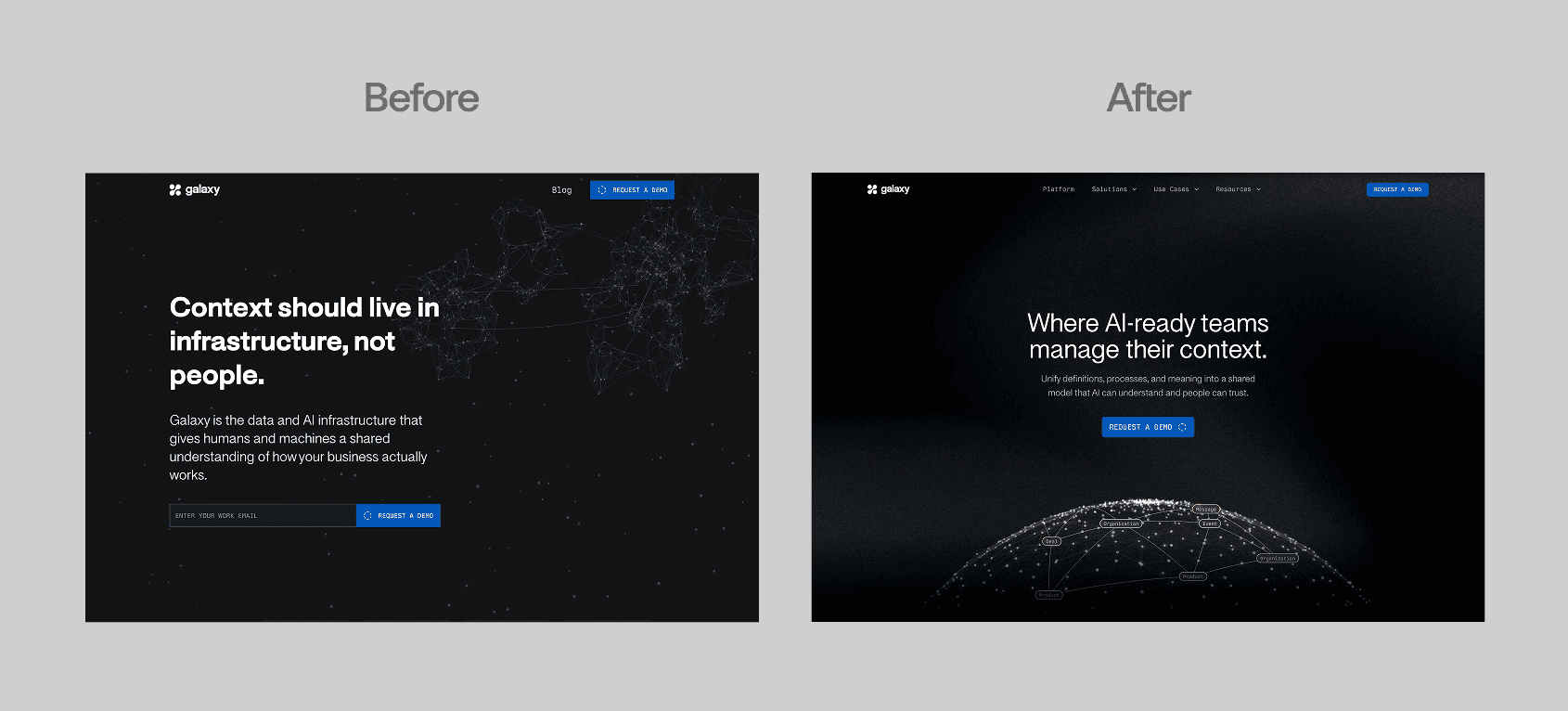
Galaxy's redesign • Design by Jun Oh Koo
Signals that actually matter
Your company changed but your website did not
Your startup raised a round, shifted positioning, entered a new market, or evolved its product significantly, but the website still tells the old story. This is not a cosmetic problem, it is a structural misalignment.
When your website describes a company that no longer exists, it creates confusion at every touchpoint. Investors see one thing in your deck and something different on your site. Prospects cannot tell if your product is for them because the messaging was written for a different audience.
The fix is almost always a full redesign, not a refresh. If the underlying positioning has changed, new copy on the same structure will not solve it.
Low conversions despite good traffic
If you are getting visitors but they are not converting, the website might be the problem. But only after you have checked everything else first.
Conversion issues are rarely design problems. They are traffic quality problems, offer problems, or pricing problems. If you are sending the wrong audience to your site, no redesign will fix that.
But if the traffic is right and the product is strong and people are still bouncing, the site is failing at its job. Unclear value propositions, confusing navigation, weak calls to action, or visual quality that undermines trust.
Wrong impression on investors
If you have heard feedback like "your website does not reflect the quality of what you are building" or "I almost did not take the meeting because of your site," that is a clear signal. Your website is actively working against you.
The damage here is invisible. You do not see the investors who visited your site and decided not to respond. You do not see the candidates who kept scrolling. The cost shows up as opportunities that never started, not as deals that were lost.
You are embarrassed to share the link
This sounds trivial but it is not. If you hesitate before sending your website to a prospect, an investor, or a potential hire, something is wrong. Your site should feel like your best pitch, not something you need to apologize for or explain around.
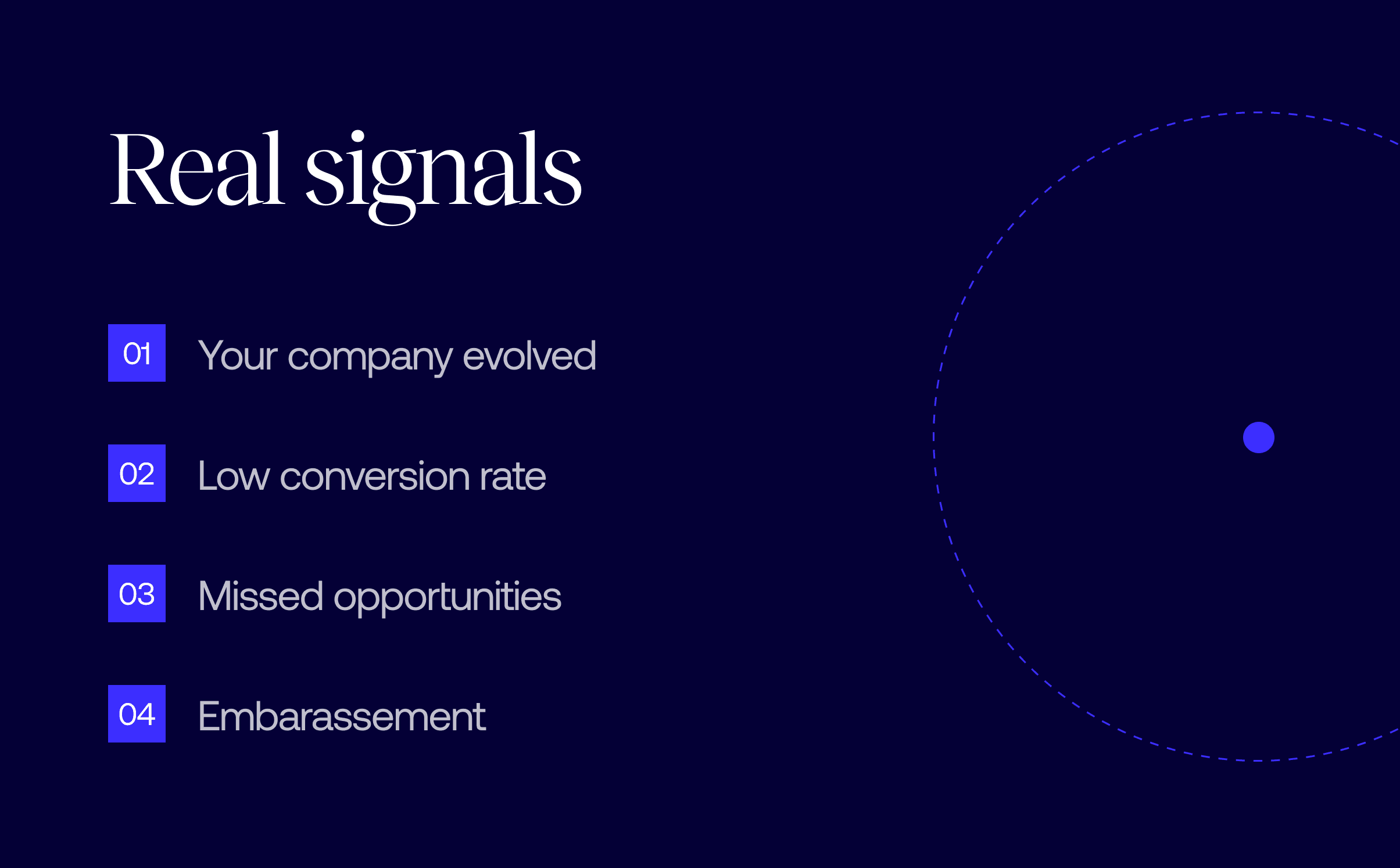
Signals that feel real but are not
You are bored with your own design
You look at your homepage every day. Of course you are tired of it. Your visitors are seeing it for the first time. Boredom is not a signal that the site is not working, it is a signal that you have seen it too many times.
A competitor just redesigned
This triggers a panic that is almost always irrational. Unless your competitor's new site is directly affecting your ability to close deals, their redesign is irrelevant to your decision.
Redesigning in response to a competitor is reactive, not strategic. Focus on whether your site is doing its job, not on what someone else's looks like.
Someone said it looks "outdated"
Design trends change constantly, and what looked modern two years ago might feel slightly dated now. But "slightly dated" and "not working" are very different things.
A website that clearly communicates your value proposition, builds credibility, and converts visitors is doing its job regardless of whether it uses the latest visual trends.
Redesigning for trends is a trap. You will spend months and thousands of dollars to look current, and two years later someone will say it looks dated again.
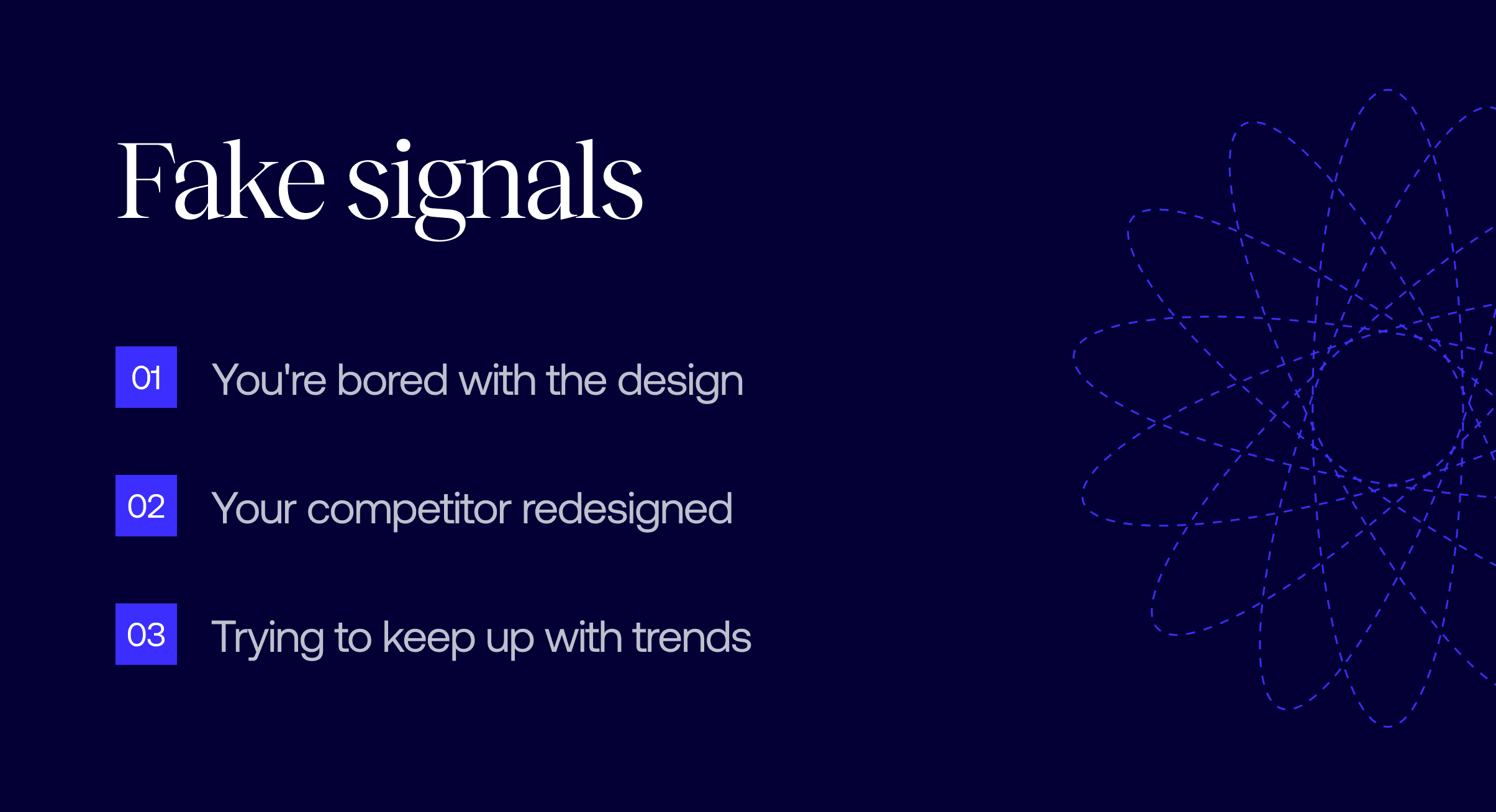
Messaging problem vs. design problem
Before committing to a redesign, figure out what is actually broken.
If your website looks fine but says the wrong things, you have a messaging problem. New copy on the existing structure could fix it in a week.
If the structure itself is wrong, the pages are organized around an old product or audience, or the navigation does not reflect how people actually use the site, that is a design problem. Design problems usually require a rebuild, not a patch.
A simple test: if rewriting every headline and paragraph on your current site would solve the issue, you do not need a redesign. You need a copywriter.
If the problem persists even with perfect copy, you need a new site.
When a refresh is enough
Not every problem requires starting from scratch. A refresh makes sense when the foundation is solid but parts have aged or underperformed.
The brand still fits. The overall structure makes sense. The design quality is still credible. But specific sections need updating: a new product feature that needs its own page, testimonials that are outdated, or a pricing page that no longer reflects the current model.
A refresh is faster, cheaper, and lower risk. The right call when the site's bones are good and the problems are localized.
When you need a full redesign
A full redesign is warranted when the gap between your company and your website is structural, not cosmetic.
You have repositioned since the site was built. You are targeting a different audience. The visual quality no longer matches the caliber of the company. Or the site was built as a quick launch and was never intended to last this long.
Patching will not close a structural gap. You need to rethink the site from strategy through execution: who it is for, what it needs to communicate, and what level of craft it needs to signal.
The best time to redesign
Some moments in a startup's lifecycle produce significantly higher ROI on a website investment than others.
Before a funding round
Your website is part of the due diligence process whether you want it to be or not. Investors will visit it. Making sure it reflects the strength of what you are building is one of the highest-leverage things you can do before a raise.
When Galaxy was preparing to go public, they had an existing website that was not built for that moment. They brought in a new design and we developed the site from that vision, building a web presence that matched the scale and credibility the company needed before going to market.

When entering a new market.
If your audience is changing, your website needs to change with it. A site built for developer tools that now needs to speak to enterprise buyers requires more than new copy. It requires a different tone, different proof points, different structure.
When hiring becomes a priority
Candidates research companies before applying. A strong website signals that the company is serious, well-run, and worth joining. A weak one raises questions that your recruiter will have to answer in every conversation.
After a major product evolution
If the product has fundamentally changed, the website should reflect the current version, not the one that launched two years ago.
The cost of waiting
The most expensive redesign is the one you needed six months ago.
Every month your website misrepresents your company, the cost compounds in ways that never show up in your analytics. Investors who do not respond and prospects who visit once and never come back.
If you have recognized your startup in the signals that actually matter, the best time to act is now.
Frequently asked questions
How often should a startup redesign its website?
There is no fixed timeline. The trigger should be a meaningful change in the company, not a calendar date. Let the gap between your website and your company drive the decision.
Can I just update the copy instead of redesigning?
If the design and structure are solid but the messaging is off, yes. New copy can fix that quickly. But if the structure itself was built around an old positioning or audience, better words on a broken foundation will not close the gap.
Should I redesign before or after raising a round?
Before, if you can. Your website is part of how investors evaluate your company. If timing is tight, even a focused refresh of the homepage before the raise can make a real difference.
What is the difference between a website refresh and a redesign?
A refresh updates elements like copy, images, or sections on an existing structure. A redesign rethinks the site from the ground up. A refresh is faster and cheaper. A redesign is necessary when the foundation no longer fits the company.
Some startups tend to redesign their website for the wrong reasons. A competitor launches a new site. A board member mentions it in passing. The founder gets bored of the same homepage. These are emotional triggers, not strategic ones.
Others wait too long. They know the site is not working but keep pushing it to next quarter while every investor, candidate, and prospect gets a distorted picture of the company.
The question is not whether your website could be better. It always could. The question is whether the gap between your website and your company is large enough to be costing you something real.
Galaxy's redesign • Design by Jun Oh Koo
Signals that actually matter
Your company changed but your website did not
Your startup raised a round, shifted positioning, entered a new market, or evolved its product significantly, but the website still tells the old story. This is not a cosmetic problem, it is a structural misalignment.
When your website describes a company that no longer exists, it creates confusion at every touchpoint. Investors see one thing in your deck and something different on your site. Prospects cannot tell if your product is for them because the messaging was written for a different audience.
The fix is almost always a full redesign, not a refresh. If the underlying positioning has changed, new copy on the same structure will not solve it.
Low conversions despite good traffic
If you are getting visitors but they are not converting, the website might be the problem. But only after you have checked everything else first.
Conversion issues are rarely design problems. They are traffic quality problems, offer problems, or pricing problems. If you are sending the wrong audience to your site, no redesign will fix that.
But if the traffic is right and the product is strong and people are still bouncing, the site is failing at its job. Unclear value propositions, confusing navigation, weak calls to action, or visual quality that undermines trust.
Wrong impression on investors
If you have heard feedback like "your website does not reflect the quality of what you are building" or "I almost did not take the meeting because of your site," that is a clear signal. Your website is actively working against you.
The damage here is invisible. You do not see the investors who visited your site and decided not to respond. You do not see the candidates who kept scrolling. The cost shows up as opportunities that never started, not as deals that were lost.
You are embarrassed to share the link
This sounds trivial but it is not. If you hesitate before sending your website to a prospect, an investor, or a potential hire, something is wrong. Your site should feel like your best pitch, not something you need to apologize for or explain around.
Signals that feel real but are not
You are bored with your own design
You look at your homepage every day. Of course you are tired of it. Your visitors are seeing it for the first time. Boredom is not a signal that the site is not working, it is a signal that you have seen it too many times.
A competitor just redesigned
This triggers a panic that is almost always irrational. Unless your competitor's new site is directly affecting your ability to close deals, their redesign is irrelevant to your decision.
Redesigning in response to a competitor is reactive, not strategic. Focus on whether your site is doing its job, not on what someone else's looks like.
Someone said it looks "outdated"
Design trends change constantly, and what looked modern two years ago might feel slightly dated now. But "slightly dated" and "not working" are very different things.
A website that clearly communicates your value proposition, builds credibility, and converts visitors is doing its job regardless of whether it uses the latest visual trends.
Redesigning for trends is a trap. You will spend months and thousands of dollars to look current, and two years later someone will say it looks dated again.
Messaging problem vs. design problem
Before committing to a redesign, figure out what is actually broken.
If your website looks fine but says the wrong things, you have a messaging problem. New copy on the existing structure could fix it in a week.
If the structure itself is wrong, the pages are organized around an old product or audience, or the navigation does not reflect how people actually use the site, that is a design problem. Design problems usually require a rebuild, not a patch.
A simple test: if rewriting every headline and paragraph on your current site would solve the issue, you do not need a redesign. You need a copywriter.
If the problem persists even with perfect copy, you need a new site.
When a refresh is enough
Not every problem requires starting from scratch. A refresh makes sense when the foundation is solid but parts have aged or underperformed.
The brand still fits. The overall structure makes sense. The design quality is still credible. But specific sections need updating: a new product feature that needs its own page, testimonials that are outdated, or a pricing page that no longer reflects the current model.
A refresh is faster, cheaper, and lower risk. The right call when the site's bones are good and the problems are localized.
When you need a full redesign
A full redesign is warranted when the gap between your company and your website is structural, not cosmetic.
You have repositioned since the site was built. You are targeting a different audience. The visual quality no longer matches the caliber of the company. Or the site was built as a quick launch and was never intended to last this long.
Patching will not close a structural gap. You need to rethink the site from strategy through execution: who it is for, what it needs to communicate, and what level of craft it needs to signal.
The best time to redesign
Some moments in a startup's lifecycle produce significantly higher ROI on a website investment than others.
Before a funding round
Your website is part of the due diligence process whether you want it to be or not. Investors will visit it. Making sure it reflects the strength of what you are building is one of the highest-leverage things you can do before a raise.
When Galaxy was preparing to go public, they had an existing website that was not built for that moment. They brought in a new design and we developed the site from that vision, building a web presence that matched the scale and credibility the company needed before going to market.
When entering a new market.
If your audience is changing, your website needs to change with it. A site built for developer tools that now needs to speak to enterprise buyers requires more than new copy. It requires a different tone, different proof points, different structure.
When hiring becomes a priority
Candidates research companies before applying. A strong website signals that the company is serious, well-run, and worth joining. A weak one raises questions that your recruiter will have to answer in every conversation.
After a major product evolution
If the product has fundamentally changed, the website should reflect the current version, not the one that launched two years ago.
The cost of waiting
The most expensive redesign is the one you needed six months ago.
Every month your website misrepresents your company, the cost compounds in ways that never show up in your analytics. Investors who do not respond and prospects who visit once and never come back.
If you have recognized your startup in the signals that actually matter, the best time to act is now.
Frequently asked questions
How often should a startup redesign its website?
There is no fixed timeline. The trigger should be a meaningful change in the company, not a calendar date. Let the gap between your website and your company drive the decision.
Can I just update the copy instead of redesigning?
If the design and structure are solid but the messaging is off, yes. New copy can fix that quickly. But if the structure itself was built around an old positioning or audience, better words on a broken foundation will not close the gap.
Should I redesign before or after raising a round?
Before, if you can. Your website is part of how investors evaluate your company. If timing is tight, even a focused refresh of the homepage before the raise can make a real difference.
What is the difference between a website refresh and a redesign?
A refresh updates elements like copy, images, or sections on an existing structure. A redesign rethinks the site from the ground up. A refresh is faster and cheaper. A redesign is necessary when the foundation no longer fits the company.
We partner with startups to develop a strong digital foundation at the moment it matters most.