Why Startups Should Invest in Design Early
Companies that treat design as a strategic function consistently outperform those that don't. Here's why and how startups can apply the same principles.

6 min read
Copy URL
Copied!
Many founders treat design as something to invest in after product-market fit. The highest-performing startups tend to do the opposite.
Research suggests that companies that embed design into strategy consistently outperform their peers in revenue growth, shareholder returns, and customer experience.
The data
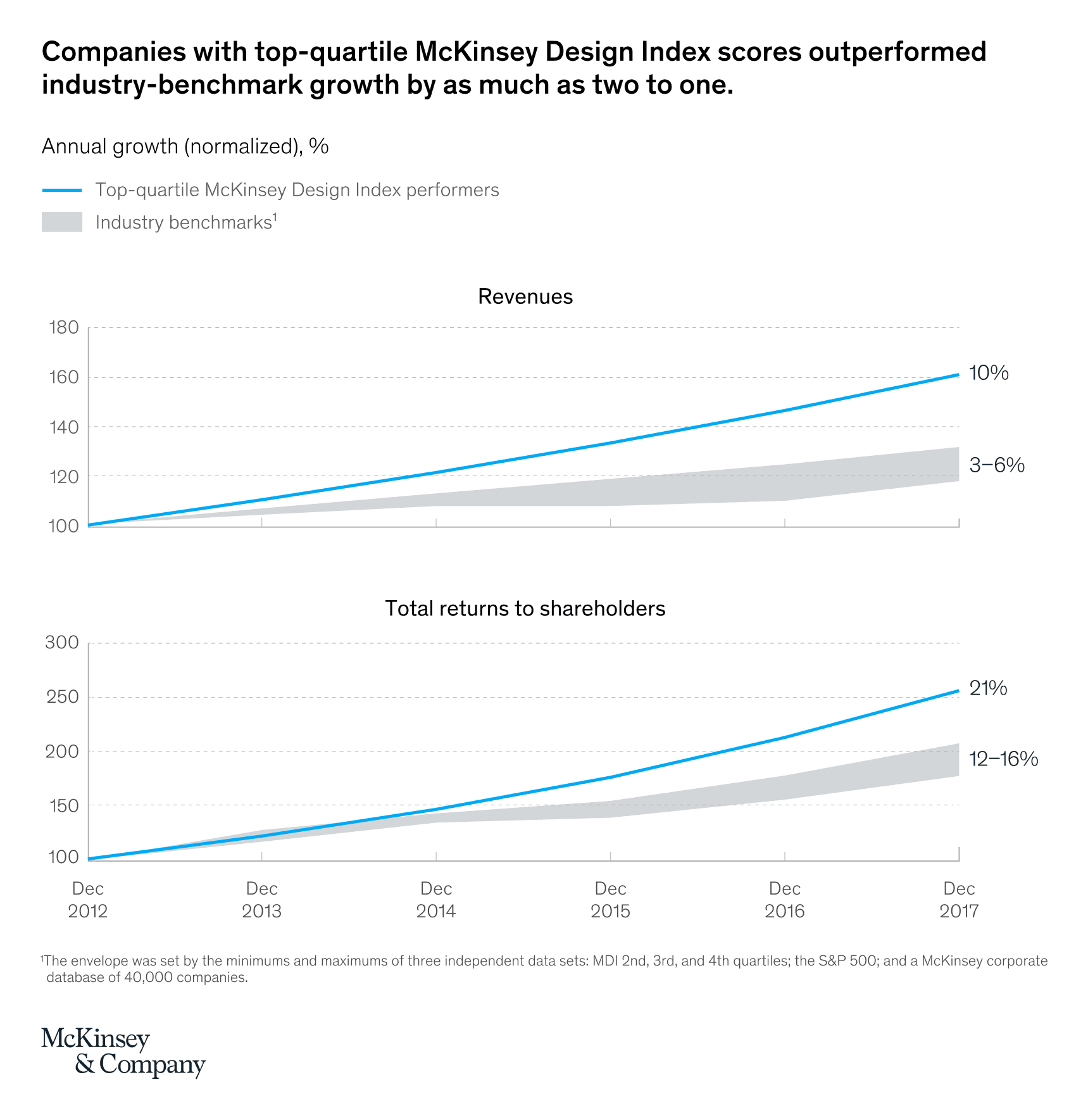
In 2018, McKinsey tracked 300 publicly listed companies over five years, analyzing more than two million pieces of financial data and 100,000 design actions. The results were clear: companies in the top quartile of their Design Index saw 32% higher revenue growth and 56% higher total returns to shareholders compared to their industry peers.
(Source: McKinsey)
These findings suggest that design is far more than aesthetics, it's a measurable business advantage.
What "design-led" means
Being design-led does not mean having a large design team, hiring a brand agency, or obsessing over pixel-perfect interfaces. It means making intentional decisions about how your company shows up at every touchpoint.
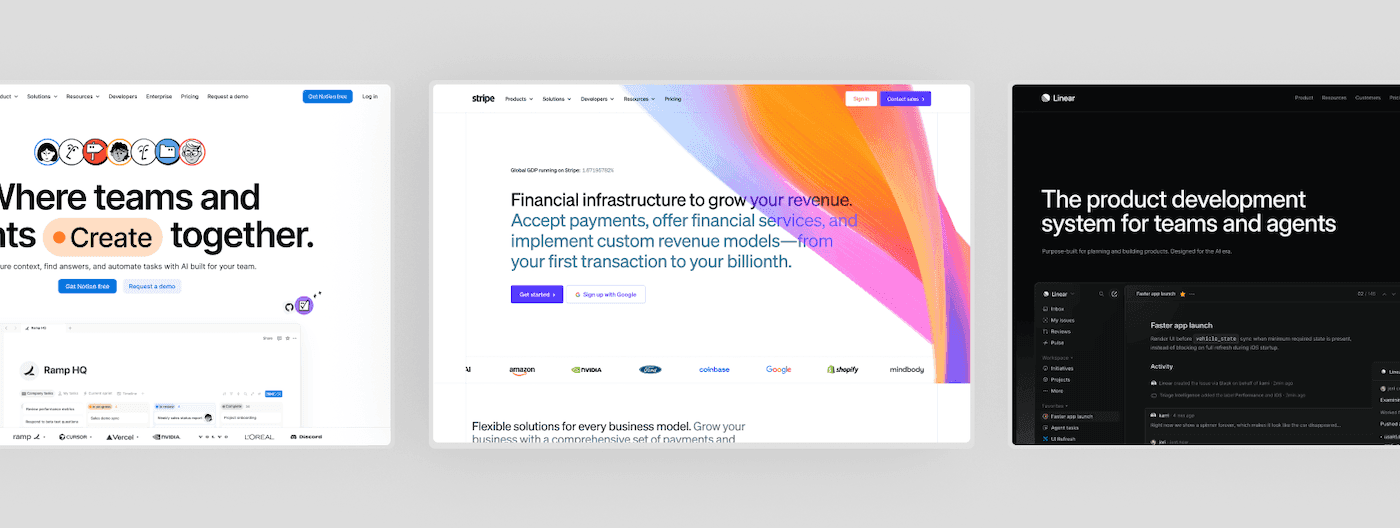
Think of the great examples that consistently come up in these conversations: Linear, Stripe, Figma, Notion, Vercel. They all share a belief that how the product looks and feels is inseparable from what the product does.
Design-led startups
Naturally, most startups cannot operate at that scale. But the principle applies at every stage.
Where design creates leverage
Fundraising
Investors evaluate your company in minutes. They scan your website, flip through your deck, and form an impression before the first conversation. A startup that presents itself with clarity and visual confidence signals competence, focus, and attention to detail.
Design does not replace a strong product or traction, but it shapes the context in which those things are evaluated.
Conversion
Most conversion gains come from reducing friction and increasing clarity, both of which are enabled by great design.
Small improvements in hierarchy, messaging, social proof and usability often have a far greater impact than founders expect.
Hiring
Candidates research companies before they apply. The website, the product, and the social presence all factor into their decision. A polished, cohesive brand signals attention to detail.
Product retention
Retention is often treated as a product problem, but many users leave long before they experience the product's real value. Clear navigation, intuitive interactions and thoughtful onboarding reduce friction during those critical first minutes.
Brand compounding
Every touchpoint is an impression. When they are visually consistent and deliberate, they create a cumulative effect that is greater than the sum of its parts.
Consistency is something people rarely notice consciously, but they reward it every time.
Where founders get it wrong
Waiting until "later"
The most common mistake is treating design as a phase that comes after product-market fit. By the time "later" arrives, the company has accumulated months or years of inconsistent assets and a brand identity that was never intentionally established.
Fixing all of this retroactively is significantly more expensive than investing incrementally from the start. It is the visual equivalent of technical debt, and it compounds the same way.
Confusing design with aesthetics
Design is about sending a message effortlessly, not just making things look good. A beautifully designed homepage that says nothing specific is worse than a plain one with a clear value proposition. Founders who chase visual trends without grounding design in strategy end up with a site that looks modern and communicates nothing.
Hiring too junior too early
A single junior designer asked to handle the website, the pitch deck, the brand, and the social content is unlikely to produce great results across all of them. Not because they lack talent, but because the scope requires a team, not a generalist.
At the early stage, a senior freelancer or a studio engagement for key moments usually produces better results than a full-time hire who is spread across too many surfaces.
How to start
You do not need a design team or a large budget to operate as a design-led company. You need to treat design as a business decision, not a finishing touch.
Start with your highest-visibility touchpoints. Your product and your website are where the majority of impressions happen. If those look intentional, consistent, and well-crafted, you are already ahead of most startups at your stage.
Establish a basic visual system early. A color palette, a typeface, a set of rules for how things look. It prevents the slow drift toward inconsistency that happens when every new asset is designed from scratch.
Bring in expertise for the moments that matter. A website redesign before a raise. A product UI audit before a major launch. These are high-leverage moments where professional design pays for itself.
Treat design decisions as business decisions. Every interaction shapes how customers, investors, and future employees perceive your company. Make those decisions deliberately rather than by default.
Design becomes a competitive advantage because it helps companies communicate more clearly, build trust faster, and create better experiences.
Frequently asked questions
Does investing in design impact startup growth?
Yes. Research shows that design-led companies achieve 32% higher revenue growth and 56% higher total shareholder returns. The correlation holds across industries and company sizes.
When should a startup start investing in design?
From the beginning, but proportionally. Early-stage startups do not need a full design team. They need intentional decisions about their highest-visibility touchpoints: the website, the pitch deck, and the product's core experience.
What does "design-led" mean for a small startup?
It means treating design as a strategic function, not a cosmetic one. Every touchpoint, from the website to the product to the sales materials, is intentionally crafted to communicate clearly and build trust.
Do I need to hire a designer to be design-led?
Not necessarily. At the early stage, working with a studio or senior freelancer for key moments often produces better results than a full-time hire spread across too many surfaces.
Can good design make up for a weak product?
Definitely not. Design amplifies what is already there. A strong product with strong design grows faster, but a weak product with strong design just looks better while failing.
Many founders treat design as something to invest in after product-market fit. The highest-performing startups tend to do the opposite.
Research suggests that companies that embed design into strategy consistently outperform their peers in revenue growth, shareholder returns, and customer experience.
The data
In 2018, McKinsey tracked 300 publicly listed companies over five years, analyzing more than two million pieces of financial data and 100,000 design actions. The results were clear: companies in the top quartile of their Design Index saw 32% higher revenue growth and 56% higher total returns to shareholders compared to their industry peers.
(Source: McKinsey)
These findings suggest that design is far more than aesthetics, it's a measurable business advantage.
What "design-led" means
Being design-led does not mean having a large design team, hiring a brand agency, or obsessing over pixel-perfect interfaces. It means making intentional decisions about how your company shows up at every touchpoint.
Think of the great examples that consistently come up in these conversations: Linear, Stripe, Figma, Notion, Vercel. They all share a belief that how the product looks and feels is inseparable from what the product does.
Design-led startups
Naturally, most startups cannot operate at that scale. But the principle applies at every stage.
Where design creates leverage
Fundraising
Investors evaluate your company in minutes. They scan your website, flip through your deck, and form an impression before the first conversation. A startup that presents itself with clarity and visual confidence signals competence, focus, and attention to detail.
Design does not replace a strong product or traction, but it shapes the context in which those things are evaluated.
Conversion
Most conversion gains come from reducing friction and increasing clarity, both of which are enabled by great design.
Small improvements in hierarchy, messaging, social proof and usability often have a far greater impact than founders expect.
Hiring
Candidates research companies before they apply. The website, the product, and the social presence all factor into their decision. A polished, cohesive brand signals attention to detail.
Product retention
Retention is often treated as a product problem, but many users leave long before they experience the product's real value. Clear navigation, intuitive interactions and thoughtful onboarding reduce friction during those critical first minutes.
Brand compounding
Every touchpoint is an impression. When they are visually consistent and deliberate, they create a cumulative effect that is greater than the sum of its parts.
Consistency is something people rarely notice consciously, but they reward it every time.
Where founders get it wrong
Waiting until "later"
The most common mistake is treating design as a phase that comes after product-market fit. By the time "later" arrives, the company has accumulated months or years of inconsistent assets and a brand identity that was never intentionally established.
Fixing all of this retroactively is significantly more expensive than investing incrementally from the start. It is the visual equivalent of technical debt, and it compounds the same way.
Confusing design with aesthetics
Design is about sending a message effortlessly, not just making things look good. A beautifully designed homepage that says nothing specific is worse than a plain one with a clear value proposition. Founders who chase visual trends without grounding design in strategy end up with a site that looks modern and communicates nothing.
Hiring too junior too early
A single junior designer asked to handle the website, the pitch deck, the brand, and the social content is unlikely to produce great results across all of them. Not because they lack talent, but because the scope requires a team, not a generalist.
At the early stage, a senior freelancer or a studio engagement for key moments usually produces better results than a full-time hire who is spread across too many surfaces.
How to start
You do not need a design team or a large budget to operate as a design-led company. You need to treat design as a business decision, not a finishing touch.
Start with your highest-visibility touchpoints. Your product and your website are where the majority of impressions happen. If those look intentional, consistent, and well-crafted, you are already ahead of most startups at your stage.
Establish a basic visual system early. A color palette, a typeface, a set of rules for how things look. It prevents the slow drift toward inconsistency that happens when every new asset is designed from scratch.
Bring in expertise for the moments that matter. A website redesign before a raise. A product UI audit before a major launch. These are high-leverage moments where professional design pays for itself.
Treat design decisions as business decisions. Every interaction shapes how customers, investors, and future employees perceive your company. Make those decisions deliberately rather than by default.
Design becomes a competitive advantage because it helps companies communicate more clearly, build trust faster, and create better experiences.
Frequently asked questions
Does investing in design impact startup growth?
Yes. Research shows that design-led companies achieve 32% higher revenue growth and 56% higher total shareholder returns. The correlation holds across industries and company sizes.
When should a startup start investing in design?
From the beginning, but proportionally. Early-stage startups do not need a full design team. They need intentional decisions about their highest-visibility touchpoints: the website, the pitch deck, and the product's core experience.
What does "design-led" mean for a small startup?
It means treating design as a strategic function, not a cosmetic one. Every touchpoint, from the website to the product to the sales materials, is intentionally crafted to communicate clearly and build trust.
Do I need to hire a designer to be design-led?
Not necessarily. At the early stage, working with a studio or senior freelancer for key moments often produces better results than a full-time hire spread across too many surfaces.
Can good design make up for a weak product?
Definitely not. Design amplifies what is already there. A strong product with strong design grows faster, but a weak product with strong design just looks better while failing.
We help growing startups use design as a competitive advantage across every customer touchpoint.

