How Much Does a SaaS Website Cost?
A clear breakdown of what a SaaS website costs at each funding stage, what drives the price up or down, and how much you should spend.

8 min read
Copy URL
Copied!
Ask a few agencies to quote the same SaaS website and the numbers can land anywhere from $5,000 to more than $75,000. Without context the spread looks arbitrary, and most founders end up guessing which end of it they belong to.
The gap is almost never about markup. It's about what the number includes, and how much strategic work happens before anyone opens a design file. The ranges below reflect typical investment ranges for B2B software companies. If you are building something outside of that, the numbers may vary.
Why there is no single price
Two companies can ask for the same thing and receive very different quotes, because they are buying different amounts of work and different levels of thinking. Those two variables move independently.
Size and complexity
A five page marketing site is not the same project as a twenty page site with a CMS, case study templates, a blog, and product pages for three different use cases. Add localization, integrations, and a design system built to scale, and the production work multiplies before anyone talks about quality.
Craft and strategic depth
This one is harder to see in a proposal, and it matters more. How well does the team understand the business, market, and buyer? How much work happens before a single screen is designed? Positioning, messaging, and refinement are what separate two projects with identical page counts and completely different outcomes.
Typical ranges at each stage
A useful way to narrow the range is to look at what the site has to accomplish for the company right now. The job changes significantly between validating an idea and selling to enterprise, and the budget should change with it.
Stage | Typical range | Main objective |
|---|---|---|
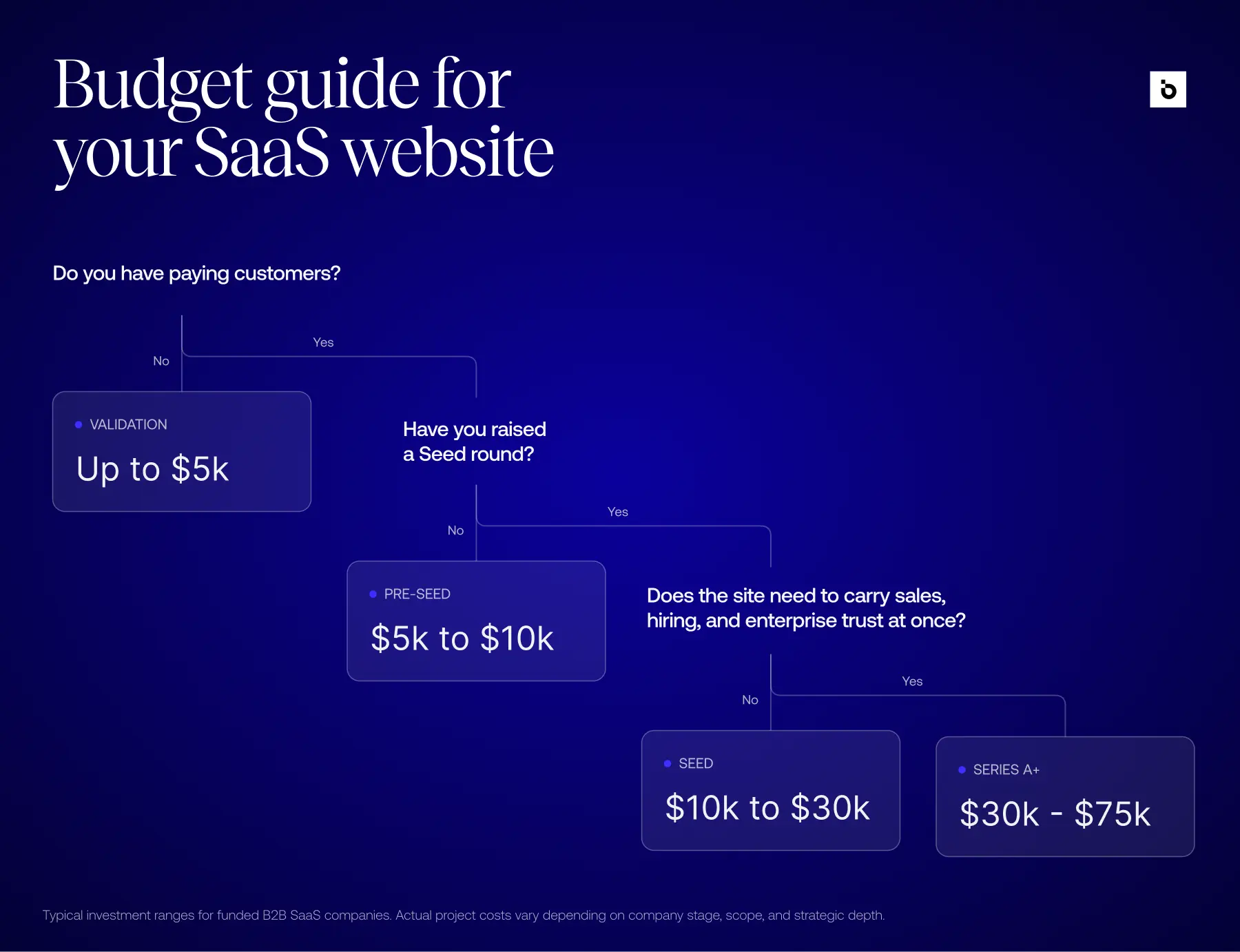
Validation | Up to $5,000 | Explain the idea and move fast |
Pre-seed | $5,000 to $10,000 | Look credible to real customers |
Seed | $10,000 to $30,000 | Strengthen positioning and convert |
Series A+ | $30,000 to $75,000 | Support sales, hiring, and enterprise trust |
Note: the ranges above are not pricing rules. Where a specific project lands depends on scope and how much strategic work is included.
Validation
Early on the website needs to explain the product clearly, capture interest, and be easy to change every week without a process around it. Speed matters more than polish.
A template, a no-code build, or an AI generated site is usually the right call here. Spending $20,000 before you know whether the positioning is correct is not discipline, it's waste. We have written separately about where AI built websites work and where they fall short, and this is the stage where they can work.
Typical investment: up to $5,000.
Pre-seed
Once real customers start evaluating your company, the website has one primary job: establish credibility. Visitors should immediately recognize a real business behind the product, with a clear offer and enough polish to inspire confidence.
You are also still learning what resonates. Product-market fit is usually in progress rather than settled, and the messaging will keep shifting as you talk to more customers. Build something solid enough to be taken seriously, but don't overinvest in a story you may rewrite in six months.
Typical investment: $5,000 to $10,000.
Seed
After a seed round the challenge shifts from proving the company exists to explaining why it matters. The website becomes the place where positioning, differentiation, and product narrative come together.
By this point you usually have enough market signal to know who you're selling to and why they buy, which changes the value of the investment. The investment shifts from production to strategy: defining the right message, structuring it effectively, and building a design system that supports the company as it grows. If you are unsure whether you are here yet, the signals are covered in when to redesign your startup website.
Typical investment: $10,000 to $30,000.
Series A and beyond
Past Series A the website is doing several jobs at once. It supports outbound sales, closes enterprise trust gaps, carries recruiting, and represents the brand in every investor conversation. It also has to scale, since you are now shipping new pages, product updates, and content on a regular cadence.
Projects at this stage often include deeper brand work, motion, a scalable CMS, and a longer strategy phase.
At the very top of the market, some of the world's leading digital studios charge $150,000 or more for comprehensive engagements that combine brand, strategy, custom illustration, motion, and complex development.
Typical investment: $30,000 to $75,000
SaaS Website Budget Framework
What actually drives the price
Most of the gap between two quotes comes down to these six things:
Number of pages. A homepage is not a website. Product pages, use case pages, pricing, about, careers, and a blog each add design and build time.
Strategy and messaging. Whether positioning and copy are included, or whether you are handing over a finished document. This is the single largest swing in most quotes.
Custom design versus adaptation. Designing from scratch against expanding an existing system or working from a template.
Illustration, 3D, and photography. Custom visual assets are their own production track and are priced accordingly.
Motion and interaction. Considered animation and interaction detail take significant time and are the difference between a site that looks fine and one people remember.
CMS and integrations. Blog structure, case study templates, localization, analytics, and product integrations all add engineering scope. Related reading: how to structure a SaaS marketing website.
When you compare proposals, compare these line by line rather than comparing totals. A $10,000 proposal and a $30,000 proposal are rarely the same project priced differently.
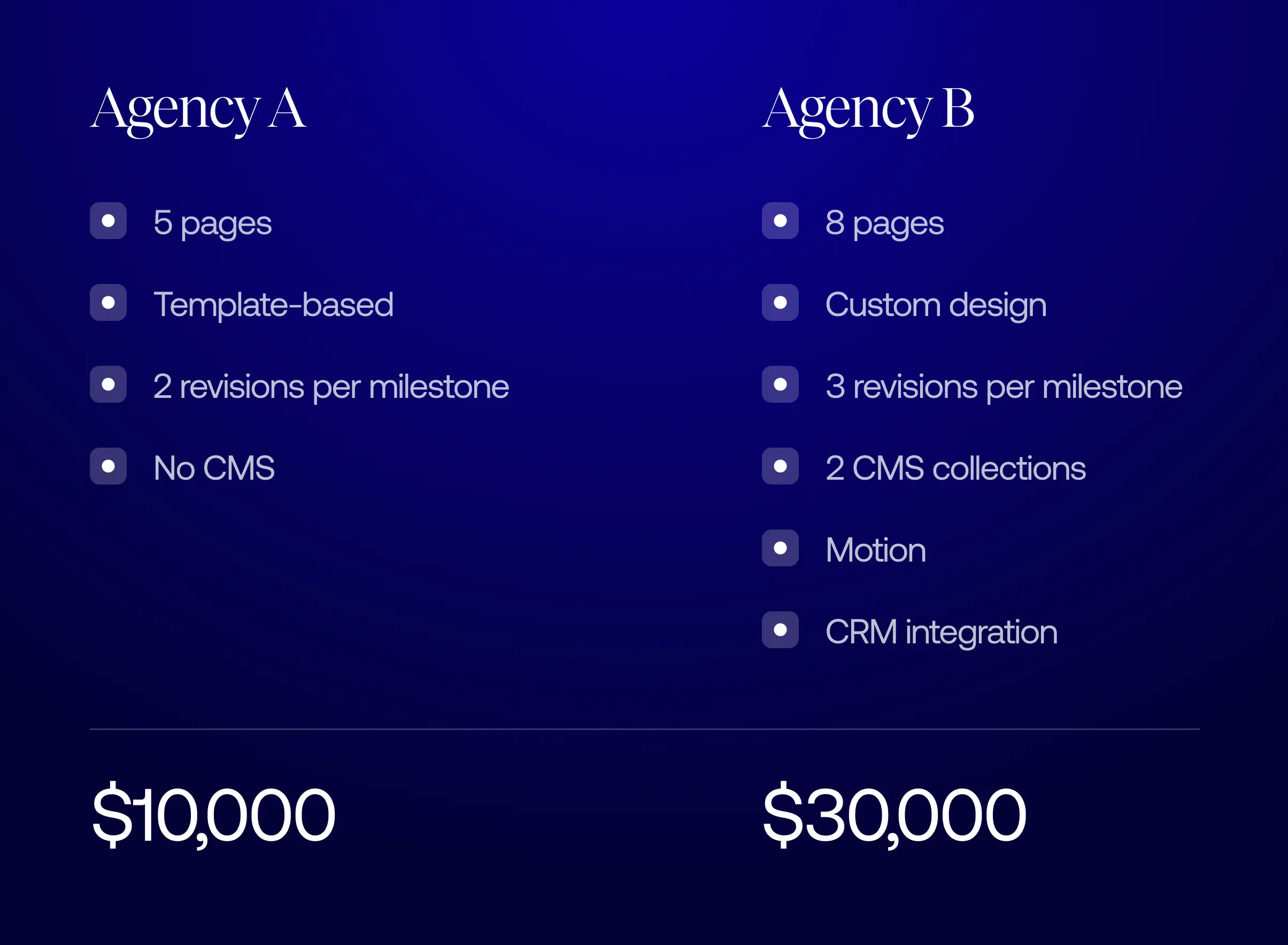
Comparing proposals
What makes a website worth $30,000?
A $30,000 website is rarely three times better looking than a $10,000 one. The difference lies in everything that happens before and around the design itself.
You're paying for more confidence in the outcome. More time spent understanding the business, exploring different directions, and validating decisions before they become expensive to change. That carries through to the execution, where stronger visual systems, scalable CMS architecture, and higher production quality all contribute to a website built for the next stage of the company.
How to make the call
Match the spend to what the site has to accomplish in the next twelve months, not to what you wish it looked like.
If you are still testing the idea, spend as little as possible and move fast. If real buyers are evaluating you, spend enough to look like a real company. If you have raised and the website is now the front door for customers, candidates, and investors at once, treat it as infrastructure and fund it accordingly. Looking at strong SaaS websites examples is a fast way to calibrate what your stage actually requires.
The mistake isn't spending too much or too little. It's solving a pre-seed problem with a seed budget, or running a Series A company on a website built to validate an idea.
Frequently asked questions
How much does a SaaS website cost?
For funded B2B SaaS companies, most projects fall anywhere between $5,000 and $75,000. Seed stage companies typically invest $10,000 to $30,000 for a custom design with deep strategy work. Pre-seed companies usually spend under $10,000.
Why do web design agencies charge so differently?
The main variable is whether strategy, messaging, and custom design are included, or whether the engagement is production only. Page count, custom assets, motion, and CMS complexity account for most of the remaining difference.
Can AI build a SaaS website for less?
Yes, and for early validation that is often the right choice. AI tools handle production well, but they do not define positioning or make the strategic decisions that determine whether a site converts.
How long does a SaaS website project take?
Template-based builds take days. A smaller production focused engagement typically runs two to four weeks. A strategy-led studio project usually runs four to ten weeks depending on scope and how quickly feedback comes back.
Do agencies charge hourly or fixed price?
Most studio engagements are fixed price, scoped against a defined deliverable. Hourly is more common with freelancers and with ongoing retainer work after launch.
Ask a few agencies to quote the same SaaS website and the numbers can land anywhere from $5,000 to more than $75,000. Without context the spread looks arbitrary, and most founders end up guessing which end of it they belong to.
The gap is almost never about markup. It's about what the number includes, and how much strategic work happens before anyone opens a design file. The ranges below reflect typical investment ranges for B2B software companies. If you are building something outside of that, the numbers may vary.
Why there is no single price
Two companies can ask for the same thing and receive very different quotes, because they are buying different amounts of work and different levels of thinking. Those two variables move independently.
Size and complexity
A five page marketing site is not the same project as a twenty page site with a CMS, case study templates, a blog, and product pages for three different use cases. Add localization, integrations, and a design system built to scale, and the production work multiplies before anyone talks about quality.
Craft and strategic depth
This one is harder to see in a proposal, and it matters more. How well does the team understand the business, market, and buyer? How much work happens before a single screen is designed? Positioning, messaging, and refinement are what separate two projects with identical page counts and completely different outcomes.
Typical ranges at each stage
A useful way to narrow the range is to look at what the site has to accomplish for the company right now. The job changes significantly between validating an idea and selling to enterprise, and the budget should change with it.
Stage | Typical range | Main objective |
|---|---|---|
Validation | Up to $5,000 | Explain the idea and move fast |
Pre-seed | $5,000 to $10,000 | Look credible to real customers |
Seed | $10,000 to $30,000 | Strengthen positioning and convert |
Series A+ | $30,000 to $75,000 | Support sales, hiring, and enterprise trust |
Note: the ranges above are not pricing rules. Where a specific project lands depends on scope and how much strategic work is included.
Validation
Early on the website needs to explain the product clearly, capture interest, and be easy to change every week without a process around it. Speed matters more than polish.
A template, a no-code build, or an AI generated site is usually the right call here. Spending $20,000 before you know whether the positioning is correct is not discipline, it's waste. We have written separately about where AI built websites work and where they fall short, and this is the stage where they can work.
Typical investment: up to $5,000.
Pre-seed
Once real customers start evaluating your company, the website has one primary job: establish credibility. Visitors should immediately recognize a real business behind the product, with a clear offer and enough polish to inspire confidence.
You are also still learning what resonates. Product-market fit is usually in progress rather than settled, and the messaging will keep shifting as you talk to more customers. Build something solid enough to be taken seriously, but don't overinvest in a story you may rewrite in six months.
Typical investment: $5,000 to $10,000.
Seed
After a seed round the challenge shifts from proving the company exists to explaining why it matters. The website becomes the place where positioning, differentiation, and product narrative come together.
By this point you usually have enough market signal to know who you're selling to and why they buy, which changes the value of the investment. The investment shifts from production to strategy: defining the right message, structuring it effectively, and building a design system that supports the company as it grows. If you are unsure whether you are here yet, the signals are covered in when to redesign your startup website.
Typical investment: $10,000 to $30,000.
Series A and beyond
Past Series A the website is doing several jobs at once. It supports outbound sales, closes enterprise trust gaps, carries recruiting, and represents the brand in every investor conversation. It also has to scale, since you are now shipping new pages, product updates, and content on a regular cadence.
Projects at this stage often include deeper brand work, motion, a scalable CMS, and a longer strategy phase.
At the very top of the market, some of the world's leading digital studios charge $150,000 or more for comprehensive engagements that combine brand, strategy, custom illustration, motion, and complex development.
Typical investment: $30,000 to $75,000
SaaS Website Budget Framework
What actually drives the price
Most of the gap between two quotes comes down to these six things:
Number of pages. A homepage is not a website. Product pages, use case pages, pricing, about, careers, and a blog each add design and build time.
Strategy and messaging. Whether positioning and copy are included, or whether you are handing over a finished document. This is the single largest swing in most quotes.
Custom design versus adaptation. Designing from scratch against expanding an existing system or working from a template.
Illustration, 3D, and photography. Custom visual assets are their own production track and are priced accordingly.
Motion and interaction. Considered animation and interaction detail take significant time and are the difference between a site that looks fine and one people remember.
CMS and integrations. Blog structure, case study templates, localization, analytics, and product integrations all add engineering scope. Related reading: how to structure a SaaS marketing website.
When you compare proposals, compare these line by line rather than comparing totals. A $10,000 proposal and a $30,000 proposal are rarely the same project priced differently.
Comparing proposals
What makes a website worth $30,000?
A $30,000 website is rarely three times better looking than a $10,000 one. The difference lies in everything that happens before and around the design itself.
You're paying for more confidence in the outcome. More time spent understanding the business, exploring different directions, and validating decisions before they become expensive to change. That carries through to the execution, where stronger visual systems, scalable CMS architecture, and higher production quality all contribute to a website built for the next stage of the company.
How to make the call
Match the spend to what the site has to accomplish in the next twelve months, not to what you wish it looked like.
If you are still testing the idea, spend as little as possible and move fast. If real buyers are evaluating you, spend enough to look like a real company. If you have raised and the website is now the front door for customers, candidates, and investors at once, treat it as infrastructure and fund it accordingly. Looking at strong SaaS websites examples is a fast way to calibrate what your stage actually requires.
The mistake isn't spending too much or too little. It's solving a pre-seed problem with a seed budget, or running a Series A company on a website built to validate an idea.
Frequently asked questions
How much does a SaaS website cost?
For funded B2B SaaS companies, most projects fall anywhere between $5,000 and $75,000. Seed stage companies typically invest $10,000 to $30,000 for a custom design with deep strategy work. Pre-seed companies usually spend under $10,000.
Why do web design agencies charge so differently?
The main variable is whether strategy, messaging, and custom design are included, or whether the engagement is production only. Page count, custom assets, motion, and CMS complexity account for most of the remaining difference.
Can AI build a SaaS website for less?
Yes, and for early validation that is often the right choice. AI tools handle production well, but they do not define positioning or make the strategic decisions that determine whether a site converts.
How long does a SaaS website project take?
Template-based builds take days. A smaller production focused engagement typically runs two to four weeks. A strategy-led studio project usually runs four to ten weeks depending on scope and how quickly feedback comes back.
Do agencies charge hourly or fixed price?
Most studio engagements are fixed price, scoped against a defined deliverable. Hourly is more common with freelancers and with ongoing retainer work after launch.
We partner with fast-growing startups to design websites and brands that support their next stage.